
The Zoom Party Game That Saves Friend Groups from Silence
You're three minutes into your weekly Zoom catch-up with friends. Someone's telling a story about their cat. Two people have their cameras off. Another friend is clearly scrolling through Instagram. The host is desperately searching for something—anything—to spark actual conversation.
Sound familiar?
Virtual hangouts don't have to feel like mandatory work meetings. What if you could transform that awkward silence into ten minutes of laughter, accusations, and genuine connection—with zero downloads, no prep time, and just one shared link?
Enter the word-based social deduction game that's saving friend groups from Zoom fatigue everywhere. It's fast, it's hilarious, and it actually gets people talking.
Table of Contents
- Why This Zoom Party Game Works
- Setup in 60 Seconds
- The 10-Minute Timeline
- Perfect Player Count
- Copy-Paste Host Scripts
- When Things Go Wrong (And How to Fix Them)
- Frequently Asked Questions
- Ready to Break the Ice?
Why This Zoom Party Game Works
Unlike trivia games that reward know-it-alls or charades that require everyone to turn their cameras on, this quick group icebreaker thrives on one simple mechanic: figuring out who's lying.
Here's the magic: Most players receive the same secret word—let's say "coffee." But one player (the impostor) gets a related word like "tea." Everyone gives one-word clues to prove they know the secret word, but here's the catch: say too much and the impostor figures it out. Say too little and you look suspicious.
It's psychological warfare disguised as a party game.
The best part? You can explain the full rules in under two minutes, and players start trash-talking each other by minute three. No complicated scoring systems, no weird avatar customization, no "let me share my screen" technical disasters.
Setup in 60 Seconds
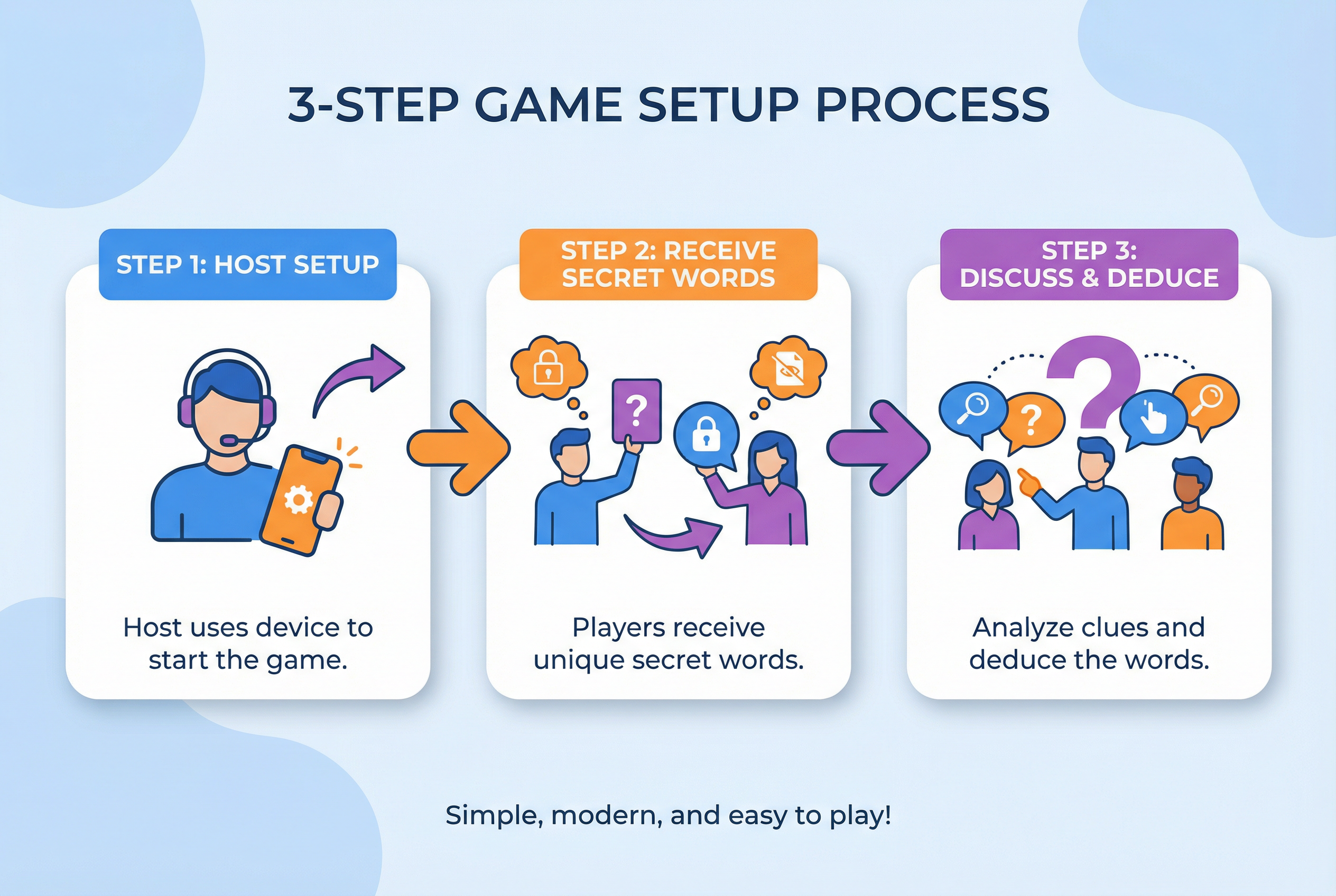
Forget elaborate preparation. Here's your real-time setup process:
0:00 - Host opens the game
While everyone's still trickling into the Zoom call, visit imposterwords.com and click "Create Room." You'll get a shareable link instantly—no account needed.
0:30 - Share the link
Drop the room code in your Zoom chat or read it out loud. Everyone clicks the link and enters their name. Takes about 15 seconds per person.
0:45 - Pick your word pack
Choose from categories like "Easy Mode" (simple word pairs like dog/cat) or "Friendship Destroyer" (wickedly similar pairs like croissant/bagel). Not sure where to start? Browse word packs organized by difficulty level.
1:00 - Hit start
The game automatically assigns roles. Everyone gets their secret word on their device. Nobody else can see it. The paranoia begins.
That's it. Sixty seconds from "hey, want to play a game?" to actual gameplay.
The 10-Minute Timeline
Here's exactly how a typical round flows when you play this online party game:
Minutes 0-2: The Secret Distribution
Each player privately views their word on their phone or computer. Six people see "apple." One person sees "orange." The impostor starts sweating.
Minutes 2-5: Clue Round
Going around the circle (or using Zoom's alphabetical list), each player gives a one-word clue. This is where the magic happens.
Real example from a recent game:
- Player 1: "Fruit"
- Player 2: "Red"
- Player 3: "Juice"
- Player 4: "Sweet" (this was the impostor)
- Player 5: "Pie"
- Player 6: "Doctor"
Notice how Player 4's clue works for both apples AND oranges? That's how impostors survive.
Minutes 5-8: Discussion Phase
Now everyone unmutes and argues. "Sarah, why did you say 'exotic'?" "Because it IS exotic!" "APPLES AREN'T EXOTIC, SARAH."
This is where your video call icebreaker transforms into a full-blown investigation. Quiet friends suddenly become lawyers presenting closing arguments. Someone inevitably says, "This is just like Among Us!" (It's not, but let them have this moment.)
Minutes 8-9: The Vote
Everyone points at who they think is the impostor. The drama peaks. Someone screams "I KNEW IT" regardless of whether they actually knew it.
Minute 10: The Reveal
The impostor reveals their word. Half the group celebrates. The other half demands a rematch immediately.
Perfect Player Count
This social deduction game adapts beautifully to different group sizes, but here's the sweet spot:
3-4 Players: Lightning Mode
Games last 5-6 minutes. Great for quick ice breakers during team standups or when you only have a few minutes. The impostor has nowhere to hide, so discussion gets intense fast.
5-7 Players: The Goldilocks Zone
This is where the game shines. Enough players for interesting discussions, small enough that everyone participates. Perfect for friend hangouts or family video calls.
8-10 Players: Chaos Theory
Longer discussions, more accusations, higher chance of hilarious confusion. Ideal for virtual parties or when you want maximum social interaction. Pro tip: use Zoom's "raise hand" feature to manage speaking order.
11+ Players: Split Into Teams
The game technically supports more, but conversations get messy. Better to create two separate rooms and compete on completion time.
Copy-Paste Host Scripts
New to hosting? Use these word-for-word scripts to sound like a confident game master:
Opening Script
"Okay everyone, we're playing a quick game called Word Impostor. Takes 10 minutes, zero downloads needed. Here's how it works: Everyone gets a secret word on their device—except one person gets a related word. We'll each give a one-word clue, then we discuss and vote on who we think is lying. If we catch the impostor, we win. If the impostor blends in, they win. Click this link and enter your name: [read room code]. Questions before we start?"
Mid-Game Correction Script
If someone breaks a rule (it happens), stay calm:
"Quick reminder: we're giving ONE WORD clues only, and you can't say your exact word or anything too obvious. If you're the impostor and you figure out our word, stay quiet until the voting phase—that's your advantage. Let's keep going!"
Wrap-Up Script
After the reveal, keep momentum going:
"Alright, that was [impostor's name]! Let's quickly discuss—what clues gave it away? [allow 30 seconds of post-game analysis] Want to run another round with a harder category? I can start a new game in 10 seconds."
When Things Go Wrong (And How to Fix Them)
Even the smoothest video call icebreaker hits snags. Here's your troubleshooting guide:
Problem: The Group Goes Silent
You asked for clues and got cricket sounds. This happens when players are too worried about giving themselves away.
Quick Fix: Go first as the host. Give an enthusiastic, confident clue even if you're the impostor. Energy is contagious. After two people participate, others follow.
Script: "I'll start to show you how it works: My clue is 'crunchy.' See? Just one word, kind of helpful but not too obvious. Sarah, you're next!"
Problem: Someone Blurts Out the Word
Taylor just yelled "IS IT PENGUIN?" in the middle of the clue round. Congratulations, Taylor ruined everything.
Quick Fix: Laugh it off and restart with a new word. Don't shame the player—first-time mistakes are common.
Script: "Okay Taylor, we don't say the word out loud! That's the whole game! [laugh] Let me start a fresh round with a new word. Taylor, you're still playing but maybe keep that enthusiasm for the discussion phase."
Problem: One Person Dominates
Marcus has given a TED talk for the last three minutes about why everyone except him is suspicious. Nobody else can get a word in.
Quick Fix: Institute a 30-second rule per person during discussion, or use Zoom's chat feature for quieter players to share theories.
Script: "Love the detective work, Marcus! Let's hear from people who haven't shared yet. Jamie, what's your take? Then we'll come back to Marcus."
Problem: Connection Issues
Someone's video froze mid-clue, or their audio cut out during the crucial vote.
Quick Fix: Have them type their clue/vote in Zoom chat as backup. If multiple people are laggy, switch to text-only mode where everyone types their clues.
Script: "If your connection is wonky, just type your clue and vote in the chat. We'll go by timestamp order. No biggie!"
Frequently Asked Questions
Can we play with people who aren't in the Zoom call?
Yes! The game works on any device with a browser. Someone could be on their phone in another state, someone else on a computer in the same room. Everyone just needs the room link and the Zoom call for discussion.
What if the impostor has no idea how to give a clue?
That's part of the challenge! The impostor should give clues that could apply to multiple words in the category. Want the impostor's perspective? Check out our strategy guide for sneaky tips.
How do we make it harder for experienced players?
Use tricky word pairs like "croissant/bagel" or "violin/cello." The closer the words, the harder it is to catch the impostor. You can also add a rule where you can't use any clues that previous players used.
Can kids play this game?
Absolutely! Use the "Easy Mode" word packs with simple pairs like "dog/cat" or "sun/moon." Kids as young as 8-10 usually grasp the concept quickly. Just explain that the impostor isn't "bad"—they're playing a role like in pretend games.
What if we only have 5 minutes?
Skip straight to one round with a simple word pair. Use the "lightning discussion" rule: 60 seconds of discussion maximum before voting. You can finish a complete game in under 5 minutes.
Do we need to keep the Zoom call running during the whole game?
Yes! The game site handles the secret words and mechanics, but Zoom (or Google Meet, or any video call) is where the actual gameplay happens. You'll discuss, debate, and vote using your video call. Think of the game site as your dealer and Zoom as your poker table.
Can we play multiple rounds back-to-back?
Definitely! Most groups play 3-5 rounds in a row once they get hooked. Pro tip: alternate between easy and hard word packs to keep things fresh. The host can start a new round in literally 10 seconds.
What's the deal with word packs? Do we need to pay?
Nope! You can pick a word pack from dozens of free categories ranging from "Animals" to "Abstract Concepts." Want something specific for your group? There are themed packs for everything from food to pop culture.
Ready to Break the Ice?
Here's what happens when you actually try this at your next virtual hangout: The first round feels a bit awkward (normal). By round two, everyone's yelling accusations at each other. By round three, someone's taking notes on clue patterns like they're preparing for trial.
It's the rare group game on Zoom that needs no tutorial videos, no complicated rules explanation, and no "let me share my screen to show you how this works." You just... play.
Your next Zoom call doesn't have to be three friends talking while five others scroll TikTok. It could be ten minutes of chaos, laughter, and the kind of ridiculous arguments that become inside jokes for months.
Ready to save your next video call from awkward silence? Head to imposterwords.com, create a room, and send the link to your friends. You'll be accusing each other of betrayal within minutes.
Because sometimes the best way to bring people together is giving them someone to vote against.